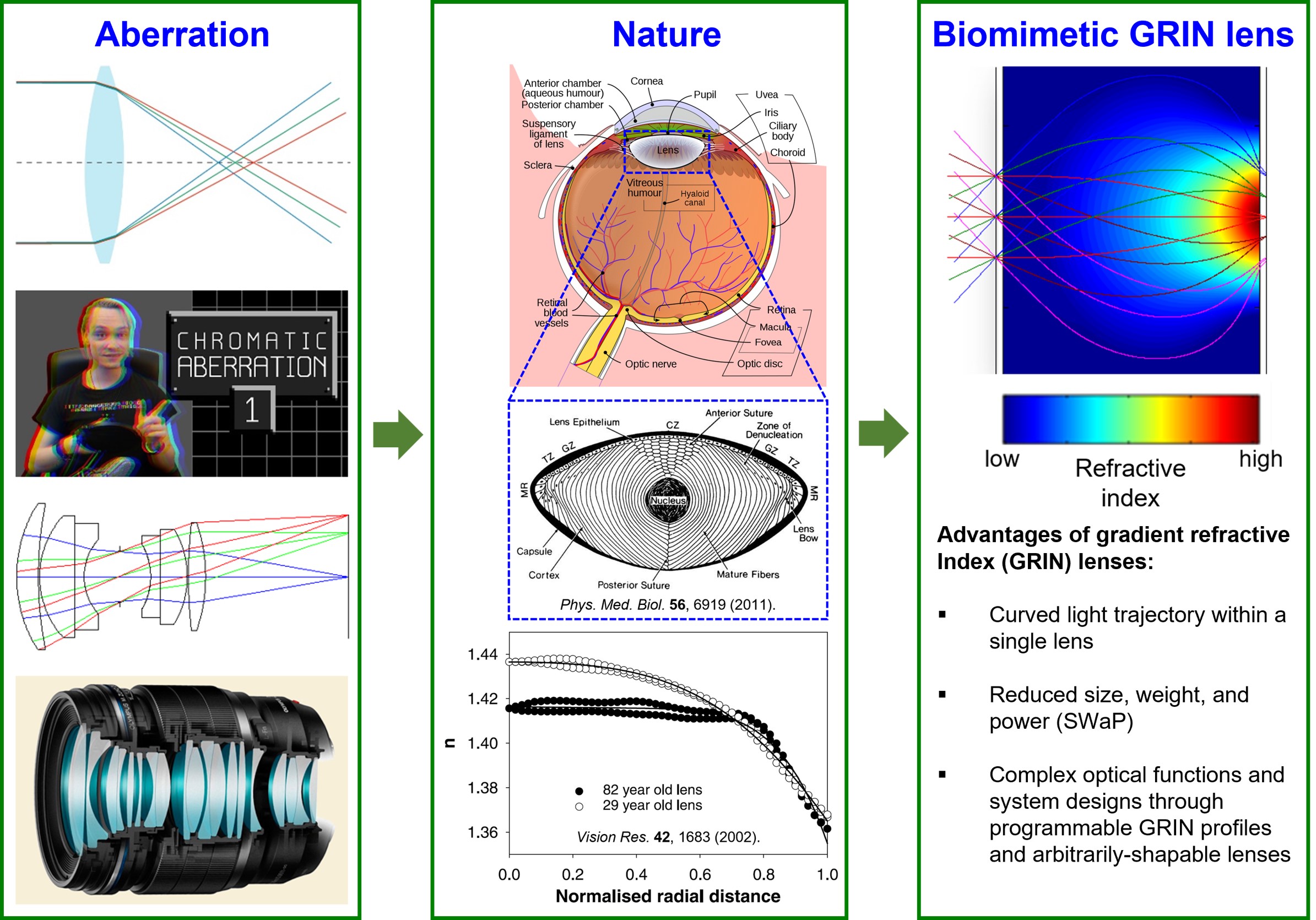
Research Goal: The development of a single optical component where its properties are required to spatially vary, such as gradient refractive index (GRIN) materials, bolsters the call for the new strategy on the fabrication and characterization of glass-ceramic materials that are scalable and multi-faceted, respectively. Here, we employ Ge-As-Pb-Se chalcogenide glasses as a testbed starting material and demonstrate a controlled crystallization process developed for their conversion into spatially tuned glass-ceramic nanocomposites.
Funding Agency: DARPA-FOCII (current) & Physical Science Inc (recent)
Participants: Junior B. J. Sop Tagne and Zephyr G. Ramsey
Relevant Publications:
- G. B. J. Sop Tagne,† Z. G. Ramsey,† L. Tran, A. M. Teijeira, K. S. Matthies, J. E. Lyza, P. E. Lynch, C. J. Cano, P. M. Marrero, R. A. Alvarez-Aguirre, D. Wiedeman, R. Sharma, C. Kosan, S. Banker, N. S. Kochan, K. A. Richardson, S. A. Feller, R. S. Welch, S. T. Misture, D. G. Stohr, K. Wang, S. K. Sundaram, and M. Kang,* “Scalable Manufacturing and Multi-faceted Cross-Correlating Characterization of Low-Dispersion Bulk Gradient Refractive Index Chalcogenide Materials,” to be submitted
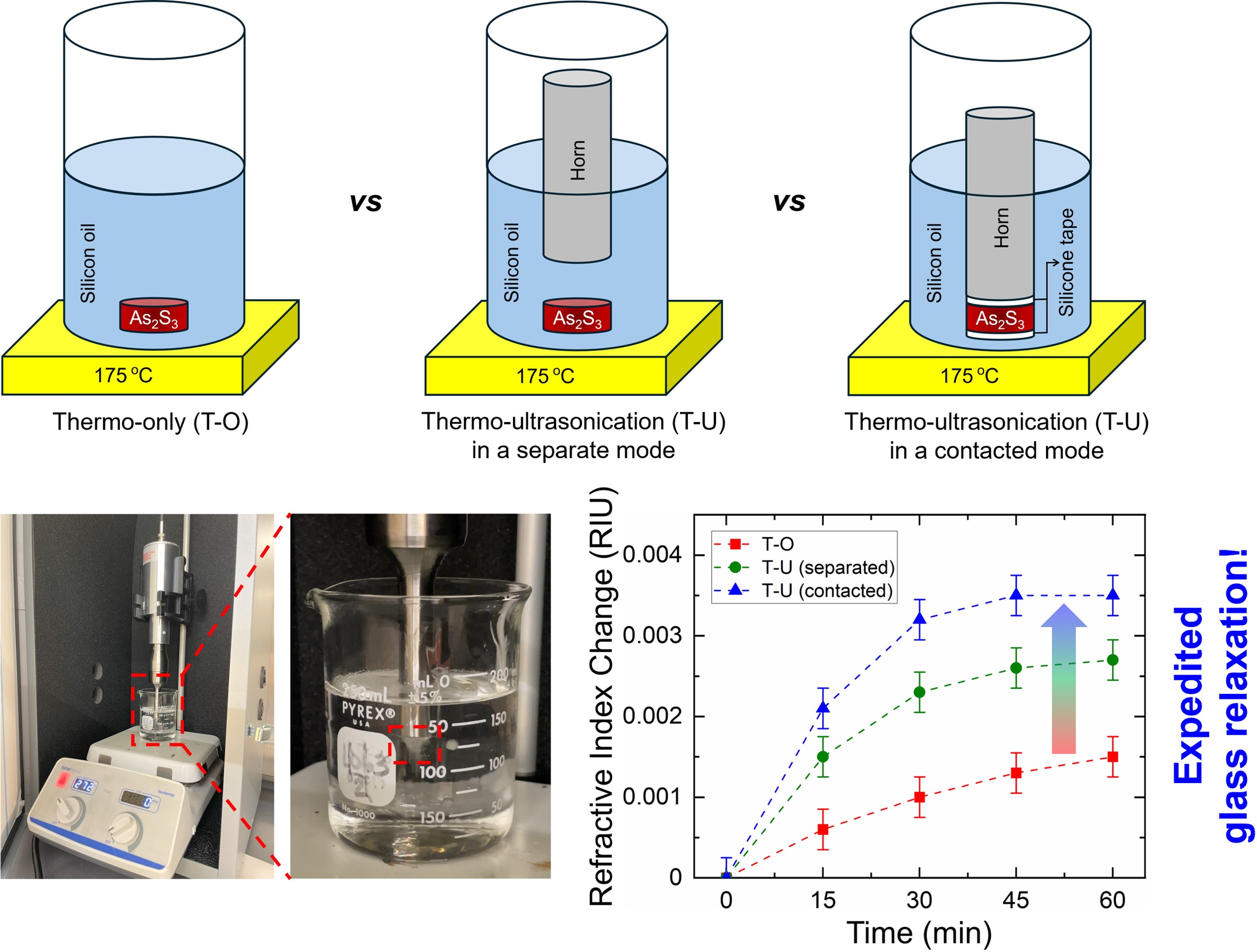
Research Goal: We seek to expedite the relaxation rate of glasses using a novel thermo-ultrasonication process. The As2S3 chalcogenide glass system is an ideal candidate due to its low Tg and prevalent use as optical materials. The samples were subjected to ultrasonic vibration at an elevated temperature below Tg to accelerate their relaxation. We employ a combined theoretical-experimental approach to study structural and stress glass relaxations. By understanding the effects of ultrasonication on glasses, we demonstrate new insights into the nature of relaxation while opening the possibility of developing ultra-stable glasses that can realize optical devices with increased lifespan.
Funding Agency: NSF-ASCENT (recent)
Participants:Lam Tran, Patrick Lynch, and Junior Sop Tagne
Relevant Publications:
- P. E. Lynch,† L. Tran,† E. A. Yamac, G. B. J. Sop Tagne, C. J. Cano, P. M. Marrero, A. J. Phillips, R. S. Welch, D. Wiedeman, R. Sharma, K. A. Richardson, S. A. Feller, W. LaCourse, S. I. Yaniger, C. J. Wilkinson, and M. Kang*, “Accelerated Low-Temperature Stabilization of Glasses via Thermo-Ultrasonication,” MRS Bull. 50, 830 (2025). [†: Equal contribution, selected as the cover issue of the 2025 July issue]
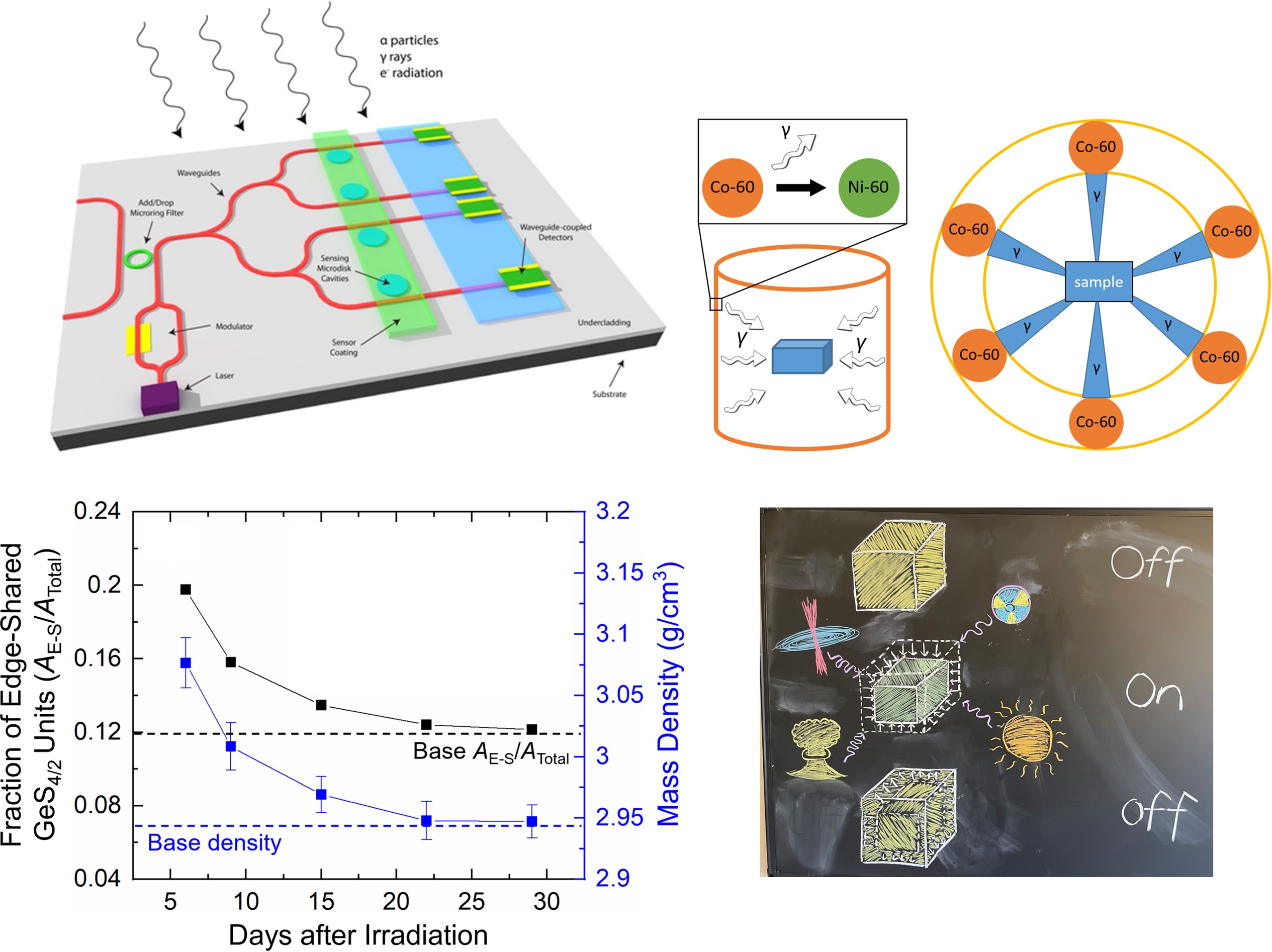
Research Goal: To correlate the time-dependent structural and optical responses of Ge-Sb-S bulk glasses to metastable topological coordination defects created by gamma-ray exposure. A combined theoretical-experimental approach is used to monitor optical, electronic, morphological, chemical, and microstructural properties as a function of time.
Funding Agency: DTRA
Participant: Patrick E. Lynch
Relevant Publications:
- M. Kang* et al., “Self-Healing Mechanisms for Ge-Sb-S Chalcogenide Glasses Upon Gamma Irradiation,” MRS Bull. 49, 778 (2024). [Cover issue]
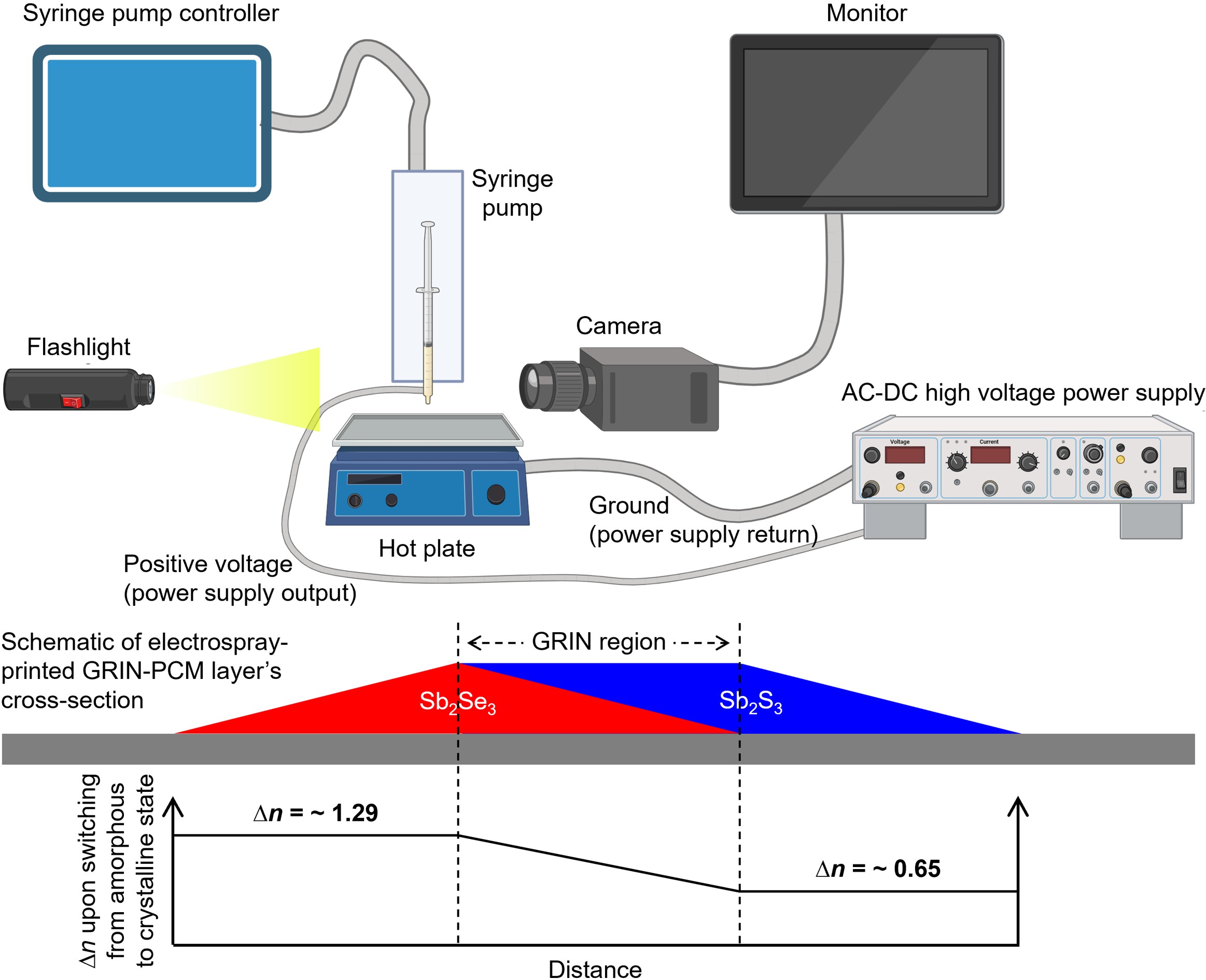
Research Goal: We plan to employ a 3-D electrospray system to co-print high figure-of-merit (FOM) Sb2S3 and Sb2Se3 optical phase change materials (PCMs). We expect our novel scalable approach to realize additively manufactured 3-D reconfigurable platforms where a versatile control of PCM’s location, form factor, and microstructure is available, thus exhibiting gradient refractive index (GRIN) change upon switching. The concept of the electrospray-aided manufacturing of spatially tailored PCMs defies the conventional wisdom that the creation of additional functionalities would lead to the complexity of the fabrication process, thus realizing a new paradigm of novel PCMs with high degrees of freedom for property engineering.
Funding Agency: DARPA-EXTREME (recent)
Participants: Lam Tran, Zephyr G. Ramsey, Junior Sop Tagne, and Patrick Lynch
Relevant Publications:
- M. Kang*, R. Sharma, C. Blanco, D. Wiedeman, Q. Altemose, P. E. Lynch, G. B. J. Sop Tagne, Y. Zhang, M. Y. Shalaginov, C.-C. Popescu, B. M. Triplett, C. Rivero-Baleine, C. M. Schwarz, A. M. Agarwal, T. Gu, J. Hu, and K. A. Richardson, “Solution-Derived Ge-Sb-Se-Te Phase-Change Chalcogenide Films,” Sci. Rep. 14, 18151 (2024).
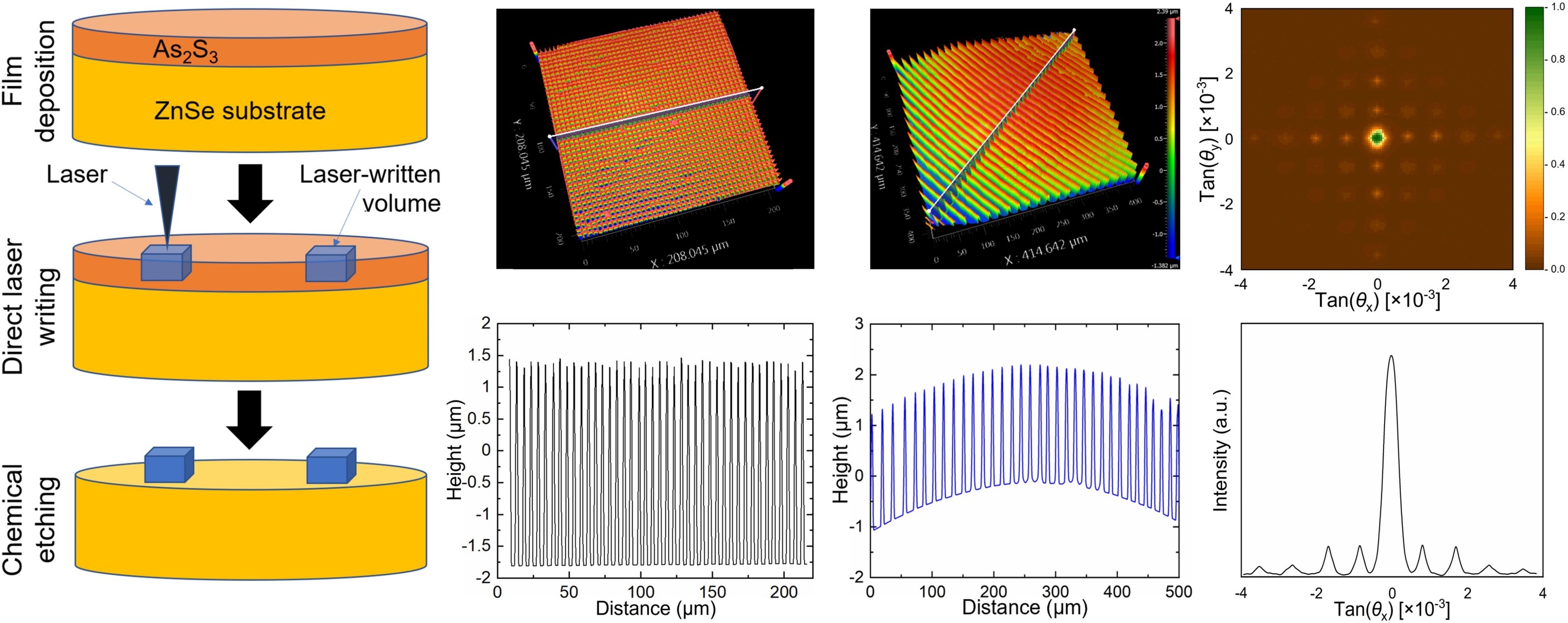
Research Goal: We employ a versatile approach for the realization of high precision micro-grating structures made of chalcogenide glass layers on either flat or curved platforms. We have demonstrated a novel photo-chemical process to spatially tailor the geometry of micro-gratings within As2S3 films and created broadband diffraction optical elements (DOEs). The flexibility of the photo-chemical process and resulting optical functionality of the DOEs provides a glimpse into our vision for grating-based thin components that rival the performance of traditional bulky optics.
Funding Agency: DARPA-EXTREME (recent)
Participants: Junior B. J. Sop Tagne
Relevant Publications:
- M. Kang†*, B. M. Triplett†, M. Y. Shalaginov†, S. Deckoff-Jones, C. Blanco, M. Truman, E. V. Shirshneva-Vashchenko, J. Cook, T. S. Karnik, Q. Du, C.-C. Popescu, A. Zachariou, Y. Zhang, C. M. Schwarz, S. An, C. Fowler, H. Zhang, I. Divliansky, L. B. Glebov, M. C. Richardson, A. M. Agarwal, C. Rivero-Baleine, J. Hu, T. Gu*, and K. A. Richardson, “Photochemically-Patterned Large-Area Arsenic Sulfide Micro-Gratings for Hybrid Diffractive-Refractive Platforms,” Adv. Photonics Res. 5, 2300241 (2024). [Selected as a cover issue]
- G. B. J. Sop Tagne, B. M. Triplett, M. Y. Shalaginov, S. Deckoff-Jones, T. S. Karnik, S. Son, M. C. Richardson, A. M. Agarwal, C. Rivero-Baleine, J. Hu, T. Gu, K. A. Richardson, and M. Kang*, “Optical Nonlinearity and Spatial Fidelity in Direct Laser Writing Process,” to be submitted
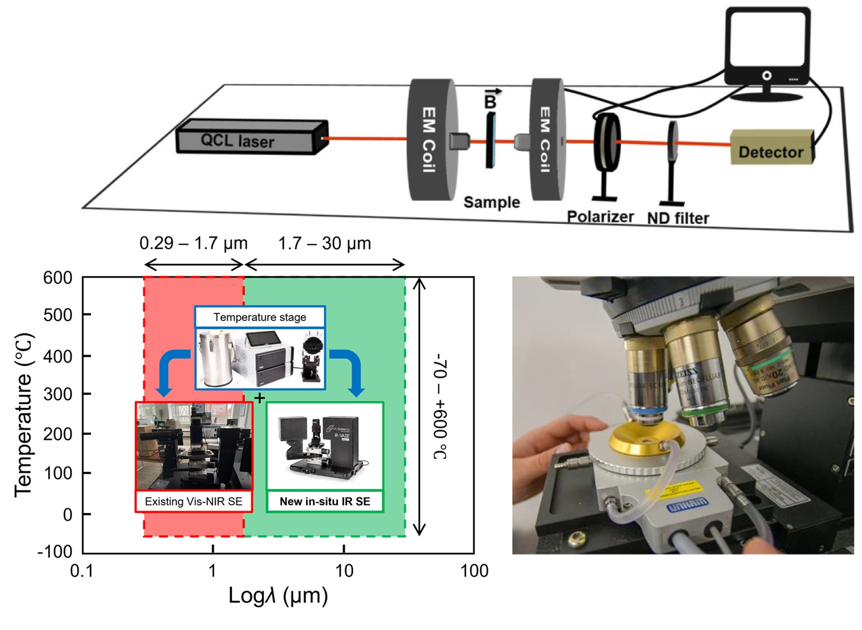
Research Goal: This proposed program aims to employ a scalable melt-quenching process to fabricate athermal germanium (Ge)-free tellurium arsenic selenide (Te-As-Se) chalcogenide glasses as an alternative to traditional temperature-sensitive Tb or Yb-doped materials for their usage in magneto-optical (MO) applications under extreme environments. Their Verdet constant will be characterized and tailored over an ultrawide spectral-thermal measurement window through quantitatively cross-correlating in-situ magneto-optical-structural metrology methods including Faraday rotation (FR), spectroscopic ellipsometry (SE), and Raman spectroscopy.
Funding Agency: Looking for an interested funding agency
Participants: Looking for interested students & collaborators
Multi-modal in-situ characterizations and their feedback into the fabrication step in a cyclic optimization process.